Who really was Mary Magdalene?
For her feast day, 22 July: what the Gospels say and what tradition built.
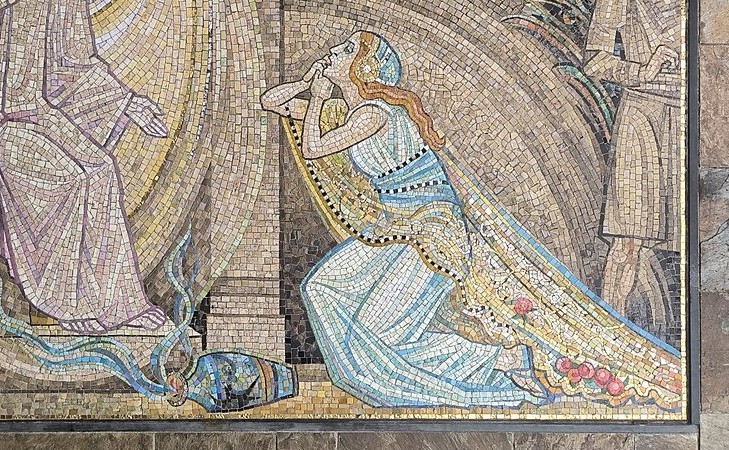
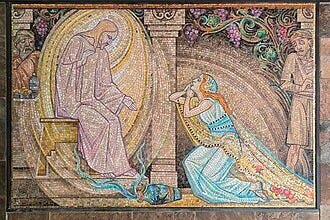
Today, 22 July, is the feast of St Mary Magdalene, kept since the early medieval period. She is an important figure in the Gospels; here are the instances where she is definitely mentioned, by name:
Introduced as Mary Magdalene, of whom Christ drove out seven demons (Luke 8:2)
One of the women who followed Jesus and supported His ministry out of their own means (Luke 8:1–3)
Present at crucifixion (Matthew 27:55-56; Mark 15:40-41)
Present at burial (Matthew 27:61; Mark 15:47)
First at the tomb; saw Him risen (Mark 16:9; John 20:1-18)
Sent by the risen Christ to announce His resurrection to the disciples (John 20:17-18)
The clearest picture of the biblical Mary Magdalene is in John 20:1-2, 11-18 (NASB2020):
(1)Now on the first day of the week Mary Magdalene came early to the tomb, while it was still dark, and saw the stone already removed from the tomb.
(2) So she ran and came to Simon Peter and to the other disciple whom Jesus loved, and said to them, “They have taken the Lord from the tomb, and we do not know where they have put Him.”
(11) But Mary was standing outside the tomb, weeping; so as she wept, she stooped to look into the tomb;
(12) and she saw two angels in white sitting, one at the head and one at the feet, where the body of Jesus had been lying.
(13) And they said to her, “Woman, why are you weeping?” She said to them, “Because they have taken away my Lord, and I do not know where they put Him.”
(14) When she had said this, she turned around and saw Jesus standing there, and yet she did not know that it was Jesus.
(15) Jesus said to her, “Woman, why are you weeping? Whom are you seeking?” Thinking that He was the gardener, she said to Him, “Sir, if you have carried Him away, tell me where you put Him, and I will take Him away.”
(16) Jesus said to her, “Mary!” She turned and said to Him in Hebrew, “Rabboni!” (which means, Teacher).
(17) Jesus said to her, “Stop clinging to Me, for I have not yet ascended to the Father; but go to My brothers and say to them, ‘I am ascending to My Father and your Father, and My God and your God.’ ”
(18) Mary Magdalene came and announced to the disciples, “I have seen the Lord,” and that He had said these things to her.
That is the whole of the biblical Mary Magdalene. We know from the Bible that Christ once drove out seven demons from her. We know she was called Mary Magdalene. She was present at the crucifixion and the burial. She was first to come to the tomb on the morning of His resurrection; she was first to see Him risen, and she was told by Him to tell His disciples about His resurrection.
Two other women in the Gospels also came to be identified with Mary Magdalene:
The unnamed sinful woman with the alabaster jar (Luke 7:36-50)
Mary of Bethany (Luke 10:38-42; John 11-12)
Why are these women treated as one person? The main reason is a homily (the sermon part of the Mass) by Pope Gregory I (Gregory the Great). In that homily, Gregory fused all three women into one: “This woman, whom Luke calls a sinner, John names Mary. I believe that she is the same Mary of whom Mark says that seven demons had been cast out.” Further, Gregory colored the sin as sexual by implying “actions which are not allowed” and that she used the ointment “as a scent for her own body”. He never specifically says that she was a prostitute; however, later in the homily he referenced a quote from Jeremiah 3:1 (which uses the image of a woman who has been unfaithful) about the sinful soul… not about Magdalene specifically. Personally, I would assume that, because of the stigma against women and because of passages like this one, the unnamed woman’s sin was read as sexual and then further hardened into prostitution. And so, Mary Magdalene became a prostitute in the medieval mind.
In reading the whole of the homily, it was really a sermon about mercy over pride, aimed at the clergy who looked down on repentant sinners. Gregory wasn’t slandering Mary Magdalene.
This belief about Mary Magdalene was largely only held in Western Christianity. The Eastern Church never accepted this fusion of the three women. They only commemorate her as the “Holy Myrrh-Bearer and Equal-to-the-Apostles”. The West went the other direction. However, the legend-building didn’t stop at merging three women. The Golden Legend was probably the most widely read book of the Middle Ages, after the Bible. The legends were compiled around 1260 by Jacobus de Voragine, a scholarly friar and later archbishop of Genoa. Its purpose was to preserve the vast store of information that pertained to church legends and traditions. It survives in a huge number of manuscripts, which for such an old text signals that it was wildly popular. Once the printing press arrived in Europe, it was among the most frequently printed books of the era.
Medieval tradition seemed to dislike leaving people mentioned in the Gospels unnamed. So, like the woman with the alabaster jar being connected to Mary Magdalene, in the Golden Legend, Martha (Lazarus and Mary of Bethany’s sister) becomes connected to the bleeding woman that Jesus healed. The anonymous voice who calls out, “Blessed is the womb that bore you”, becomes connected to Martha’s servant. The servant also gains a name: Martilla. Martha and Lazarus, after Mary of Bethany and Mary Magdalene become one, are now siblings of Mary Magdalene, and the three gain a backstory and legend.
According to the Golden Legend, Mary of Bethany/Magdalene, Lazarus, Martha, Martha’s servant Martilla, and Maximin (one of the seventy-two sent out in the Gospel of Luke) are driven out of Judea by unbelievers. They are loaded onto a boat with no sails or rudder and pushed out to sea to drown. They land in what is now Marseille, France (which was then a Roman city known as Massilia). Mary herself preaches to pagans, turning them from idolatry. She converts the whole region through preaching and miracles. Afterwards, she retires to isolation in the wilderness for the next thirty years, during which she is carried by angels seven times every day to hear the choirs in heaven. She needs no sustenance. She dies receiving communion. Later, during Charlemagne’s time in the 700s, her relics were taken to Vézelay.
In the Bible, our last scene with Mary Magdalene is her being sent by Christ to tell the disciples about His resurrection. The legend gives her a family, a ministry in France, a home in the desert for thirty years, relics, and a shrine. The legend itself grew from the early conflation of three biblical women.
What do you think? Let me know in the comments below!
Sources
Scripture quotations are from the NASB2020.
Gregory the Great, Forty Gospel Homilies, translated by Dom David Hurst (Gorgias Press, 2009). The fusion of the three women is in Homily 33, page 269; the reference to Jeremiah 3:1 is on page 277.
Jacobus de Voragine, The Golden Legend: Readings on the Saints, translated by William Granger Ryan (Princeton University Press, 2012). The Mary Magdalene chapter is chapter 96, pages 374–382.
Thanks for reading Meg Loves History! Subscribe for free to receive new posts and support my work.