The Death of William II
Do you think this was murder, accident, or divine justice? This week in 1100: William II of England was killed.
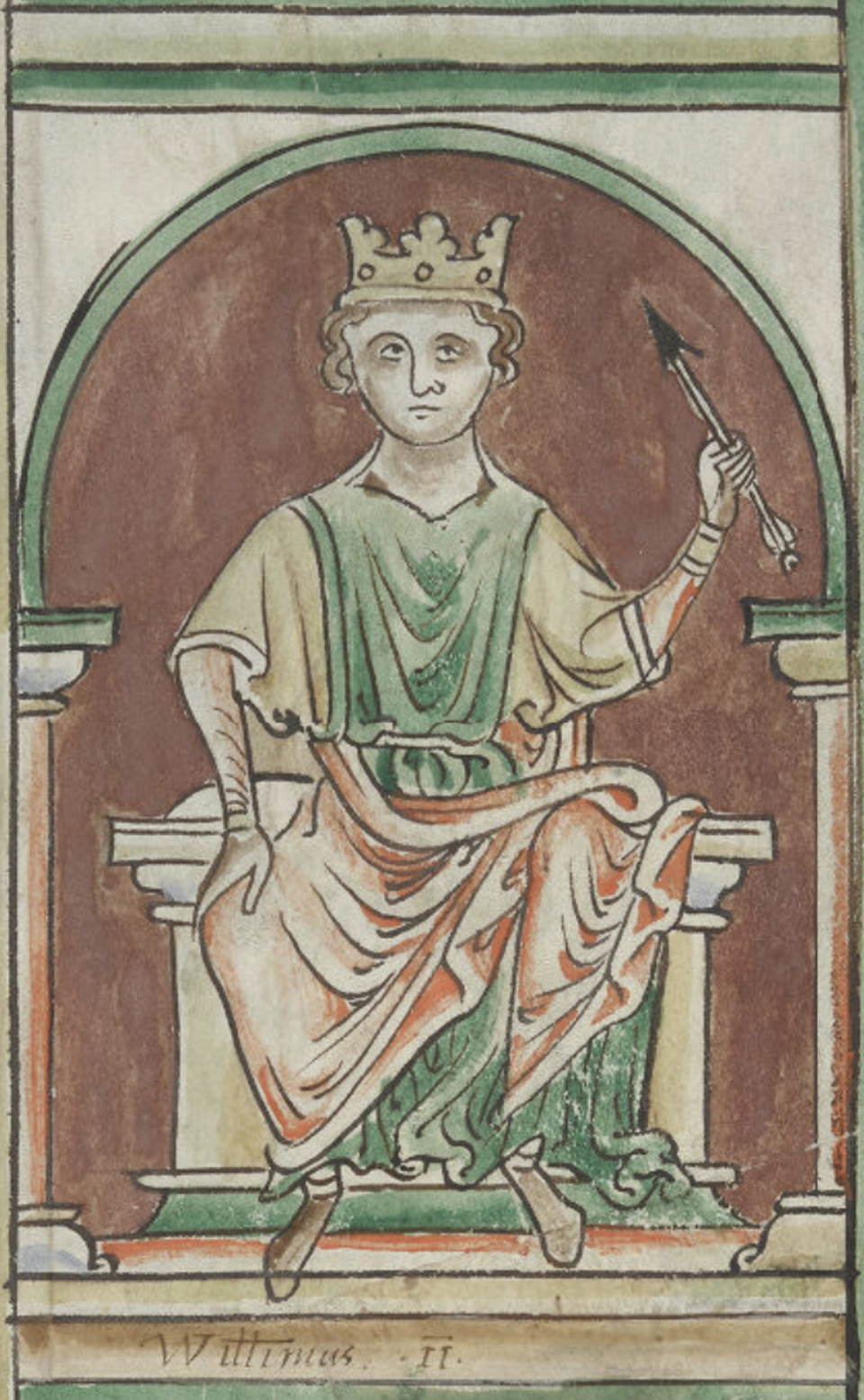
On 2 August 1100, William II, known as William Rufus, was killed by an arrow to the chest while hunting in the New Forest.
The facts
It was the day after Lammas and the Feast of St Peter in Chains (both 1 August). The king and his entourage got a late start to their hunting; instead of first thing in the morning, they went in the afternoon on this second day of stag season. The king was shot during the hunt by an arrow and quickly died. He was buried the next morning at the Old Minster in Winchester. It was the thirteenth year of his reign.
Meg Loves History is a reader-supported publication. To receive new posts and support my work, consider becoming a free or paid subscriber.
The anomaly
It was customary on a hunting day to leave at first light. William didn’t head out until afternoon, after his midday meal. This was definitely not how hunting days were done.
The maybe-whys
No one knows for sure why he didn’t go early as was usual. The sources I used do have some conjectures though:
According to the chronicler William of Malmesbury, King William may have had a hangover. He had apparently wined and dined pretty generously the day before. This makes sense to me… maybe he was celebrating the feast?
Also according to Malmesbury, there were some warning dreams by the king and some of his courtiers the night before. They were able to talk him out of a dawn hunt. If this were true, I guess the warnings didn’t hold him for long, and he went out in the afternoon.
Frank Barlow, who wrote the modern go-to biography on William II, conjectures that maybe the king just had business that morning that detained him. Maybe.
Warnings and omens
According to Orderic Vitalis, there was a monk in Gloucester that had a vision. The monk saw Jesus on the throne, with a radiant virgin (representing the church) falling at His feet and begging him to look on His people who were suffering under William’s yoke. She asked Him to take vengeance and deliver her. Jesus answered, “Be patient and wait awhile, and soon you will be amply revenged of him.” The Gloucester monk understood this vision as God having heard the Church’s cries about the robberies, adulteries, and other crimes of the king and his men. The abbot Serlo reported all this in a letter to the king; William received the letter as he was lacing his boots for the hunt.
Orderic Vitalis also says that, at the Feast of St Peter in Vinculis (St Peter in Chains, 1 August), there was the abbot of Shrewsbury, a man named Fulchered, who was preaching. He preached that England was full of iniquity, spotted with leprosy from the crown of the head to the sole of the feet and (pay attention here) "the bow of divine vengeance is bent on the reprobate, and the swift arrow taken from the quiver is ready to wound. The blow will soon be struck, but the man who is wise enough to correct his sins will avoid the infliction.”
William of Malmesbury, who hated the king, says that William II himself also had a dream the night before his death. He dreamed that he was being bled by a surgeon, but that the blood was so plentiful that it was flowing and blotting out the sun. He called on the Virgin Mary for protection. He was so frightened when he woke up that he ordered lamps to be brought into his bedchamber and for some of his servants to stay awake in the room while he slept.
Malmesbury also reports that there was a foreign monk who had a dream, and it was told to William’s man Robert FitzHamon before dawn. This monk dreamed that William came into a church in his usual menacing manner, looking with contempt at the people standing nearby. He then seized the crucifix and gnawed on it, almost tearing off the legs of the image of Jesus. The image endured this for a bit, but then it kicked the king so that he fell back. As he lay there, a huge flame came from his mouth, the smoke reaching up to the stars. When FitzHamon told the king about the dream, William laughed, saying, “He is a monk, and dreams for money like a monk; give him a hundred shillings.” Malmesbury adds though that the king was “greatly moved” and hesitated about going hunting at all that day, with his friends urging him not to test these dreams. Therefore, the king spent the morning on business and didn’t hunt until after his midday meal.
Malmesbury may have been hostile towards William, but, in my opinion, he is still a reliable source. He is generally well-regarded as a historian, although he wasn’t there and wrote about eighteen to twenty-five years after William’s death. Also worth noting is the fact that Orderic Vitalis also was not present; he was writing his chronicle in Normandy about thirty-five years after the fact. According to Frank Barlow, both chroniclers “had a weakness for the sensational.”
The day itself
Orderic Vitalis gives us what happened the day of the hunt. The king was in good spirits after his meal. He was joking around with his attendants while his boots were being laced; then, an armorer came in with six good arrows. The king examined them, praising the work. Not knowing what was going to happen that day, he kept four for himself and handed the other two to Walter Tirel, saying, “It is but right that the sharpest arrows should be given to him who knows best how to inflict mortal wounds with them.” According to Orderic, Tirel was a French knight and wealthy lord of the castles of Poix and Pontoise. He was an intimate friend and constant companion of the king’s.
It was at this point that the monk of Gloucester arrived with Serlo’s letter. The king, upon reading the letter, burst out laughing. William wondered out loud what would induce Serlo, in his simplicity of heart, to write such a letter to him about the dreams of his “snoring monks,” saying, “Does he think that I follow the example of the English, who will defer their journey or their business on account of the dreams of a parcel of wheezing old women?” Then, he mounted his horse and rode full speed into the forest.
The arrow
The two fullest accounts don’t agree on what actually happened in the forest.
Malmesbury:
The king shot at a stag, wounding it but not fatally. He shielded his eyes with his hand to watch it run. A second stag crossed in front of the men. Tirel, thinking the king wasn’t paying attention, shot at that one. The arrow went into the king’s chest. William said nothing. He broke the shaft of the arrow where it stuck out; he fell forward on the wound, hastening his own death. Tirel ran up, found the king senseless, leapt on his horse, and fled. Nobody chased him. Some looked away from the king, some pitied him, and everyone had more pressing things to do.
Orderic:
The king and Tirel positioned themselves with a few others, weapons ready, watching for game. A stag came running between the men. The king stepped out of his position, and Tirel shot at the stag. The arrow grazed the animal, glanced off it, and mortally wounded the king, who was then standing within range. He fell to the ground and died.
So, the mechanics of the king’s death differ. Malmesbury has a second stag, while Orderic has one stag and a ricochet, plus the detail of the king moving out of position first. I think it is good to note that Barlow says that Orderic’s explanation of how Tirel managed to hit the king (the whole ricochet mechanism) makes sense but is “probably imaginary”; he says the king would have had the right to the first shot.
Accident or murder?
Malmesbury and Orderic both name Walter Tirel as the man whose arrow killed the king. Orderic wrote that Tirel immediately was sought after by mercenaries and hangers-on of the king. He hurried to the coast and fled to France, apparently laughing in security. However, Suger, the abbot of the great royal abbey of Saint-Denis near Paris, in his work The Deeds of Louis the Fat (written in the 1140s), actually knew Tirel. He says that Tirel, many times, when he had nothing to fear or gain by lying, swore “as if on a holy relic” that he had not even come into that part of the forest where the king was hunting. Barlow says that the truth cannot be established; it was commonly believed at the time that Tirel was the man, and Suger is a “good but sometimes hazy” source. Barlow also says that it is possible that Tirel was only denying criminal intent. There was contemporary doubt, and many men believed that the king himself shot the fatal arrow. Tirel constantly and consistently asserted his innocence.
There is also a modern theory that the death was murder and in the interest of Count Henry (William II’s brother and the future Henry I). Barlow, however, says, “there is not a shred of good evidence and the theory merely avoids the obvious.” Barlow points to C.W. Hollister, who took the theory apart piece by piece. Hollister’s argument is that this was actually the worst possible moment for Henry to want his brother dead. The “obvious” was that hunting accidents were fairly common. Barlow’s verdict is that Tirel “could well have been the unknowing agent of the avenging God, but he was not the tool, conscious or unconscious, of an earthly prince.” He points out that Tirel was neither punished nor rewarded by Henry I. Barlow does point out, however, that most writers on this period, apart from Hollister, believed that William was murdered either on Henry’s orders or by dissidents who believed their interests would be better served with Henry on the throne.
Personally, I think this is too convenient to be an accident. William was buried within twenty-four hours of his death, which is very odd for a king, I think. Both the Church and his subjects hated William, so understandably there was very little mourning. Henry sure was quick to secure the treasury and have himself crowned King of England, knowing his older brother had a (possibly) better claim and was still in the East for the Crusade. Henry had more than enough motive to have ordered it done or to do it himself… he was on this hunting trip too, after all.
I have to disagree with Barlow. None of the “accident” scenarios make sense to me.
The idea that Tirel accidentally shot the king while aiming at a stag is absurd. I’m sure anyone would be more careful than to aim anywhere near where the king was standing.
The idea that the king may have shot the fatal arrow himself is, to me, impossible.
Regarding Orderic’s story, it is wild to think that a mere knight would be allowed to or decide to overstep decorum to make a shot before the king had the honors of the first shot.
What the church made of William’s death
In all the chronicles, the death scene is followed by the writers denouncing the actions of the king during the end part of his lifetime. Barlow says (and I agree) that these denunciations being included at this point “were surely intended to dissipate the guilt in which the whole of society was involved,” and they “helped to transfer the blame to the king himself.”
Here are the charges… note how many of them are wrongs against the church:
All four (Anglo-Saxon Chronicle, Malmesbury, Orderic Vitalis, and Abbot Suger) say that when a bishop or abbot died, the king kept the position vacant in order to pocket the revenues. The Chronicle says that William held Canterbury, Winchester, and Salisbury plus eleven abbacies, while Malmesbury says three bishoprics and twelve abbacies.
The Chronicle, Orderic, and Suger assert that William oppressed the poor with his unjust taxes as well as extorting from churches.
The Chronicle and Malmesbury say he was committing simony (the selling of church offices).
Malmesbury states that he remembers no church council being held during that time, and therefore no reforms for the good of the Church.
Malmesbury also states that William used the schism between the two popes (Pope Urban in Rome and Guibert in Ravenna) to forbid tribute payments to the Holy See.
The Chronicle and Orderic mention the quarrel between William and Anselm (the Archbishop of Canterbury). This quarrel was so bad that Anselm went into exile.
Malmesbury and Orderic talk of the king’s personal vices such as having never married, having abandoned himself to lewdness and debauchery, and promoting low-ranking men as reward for flattery.
Orderic talks about how William’s father laid waste to over sixty parishes to put in the New Forest in which William Rufus died.
The verdict
The Church seems to have put William’s death down to divine judgment. Barlow says, “When such an evident sinner perished, there was no need at all to look beyond the avenging hand of God.” If you take all the chroniclers said (the Gloucester vision, Fulchered’s sermon, Orderic talking about the New Forest deaths, and the rest of it), they definitely seem to be presenting the whole thing as God finally answering the Church’s complaints. Barlow means that as a reason to think there was nothing to find; I read it the other way, that no one went looking. My verdict is that Henry had everything to gain from his brother’s death.
Archbishop Anselm’s side of the story and the whole drama between William and the Church is a story for another time. What Henry did in the next three days, riding for the treasury at Winchester and getting himself crowned, is what we will be going over next week!
Do you think this was murder, accident, or divine justice? Let me know in the comments below!
Sources:
The Anglo-Saxon Chronicle, translated by G.N. Garmonsway (Everyman)
William of Malmesbury, Chronicle of the Kings of England, translated by John Sharpe, edited by J.A. Giles (Bohn, 1847)
Orderic Vitalis, The Ecclesiastical History of England and Normandy, translated by Thomas Forester (Bohn), volume 3
Suger, The Deeds of Louis the Fat, translated by Richard Cusimano and John Moorhead
Frank Barlow, William Rufus (Yale University Press)