On This Day, 18–21 October
A battle lost because of a chronic traitor, a king who died at the worst possible moment, and a baby who became king of two countries.
In yesterday’s Note I promised the full story about the Battle of Assandun… turns out there are two! The Anglo-Saxon Chronicle tells one, but the far more dramatic one was written a hundred years later by a churchman who loved a good yarn. Enjoy the first of two OTD roundups this week!
18 October 1016: the Battle of Assandun
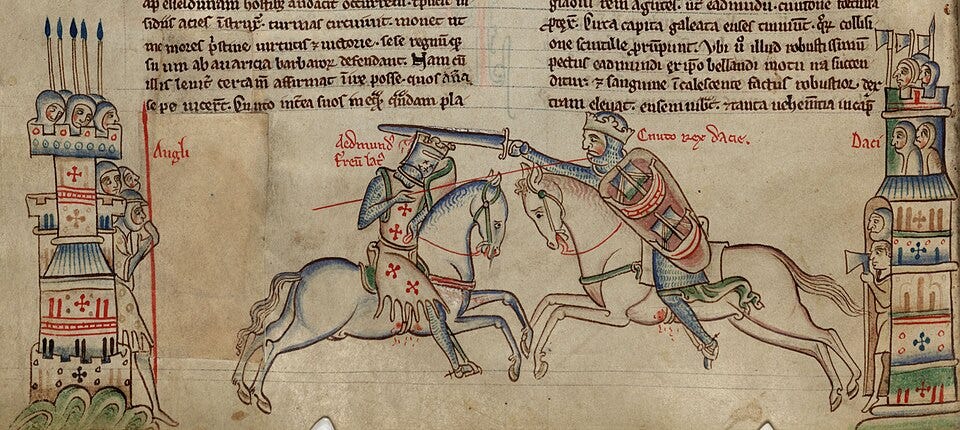
There were three kings in the year 1016. King Æthelred the Unready died on 23 April (more on him next spring). The Chronicle says “the councillors who were in London and the citizens” elected his son Edmund to be the next king. However, according to John of Worcester, the bishops, abbots, and many nobles met in Southampton and elected Cnut, son of the King of Denmark. If that sounds random, it wasn’t. Cnut’s father, Swein Forkbeard, had actually conquered England in 1013 and was accepted as king at Christmas before dying five weeks later. More on that another time! Anyway, both Edmund and Cnut claimed to be king of England, and they had to fight it out. Edmund went from London to raise his army in Wessex while Cnut had the Danish army as well as much of the north and midlands. On 18 October, Edmund caught the Danes on their way to their ships, at a hill in Essex called Assandun.
There was a nobleman named Eadric Streona, Ealdorman of Mercia. He was married to Æthelred’s daughter, Eadgyth, so he was Edmund’s brother-in-law. He had a problem of chronically switching sides… In 1015, he became Cnut’s man. In 1016, he therefore fought against Edmund at Sherston. He turned coat against Cnut, returning to Edmund later that summer. Edmund accepted him (for some unknown reason!) at Aylesford. The Anglo-Saxon Chronicle seems to be thinking along those lines; it says “…no measure could be more ill-advised.” Spoiler alert.
So, like I said before, Edmund and his army caught Cnut and his army at Assandun. Eadric was leading the Magonsæte, a people from Herefordshire and south Shropshire, on the borderlands of Cymru (Wales). During the battle, Eadric chose to be a turncoat again. He and the Magonsæte tucked tail and ran. The Chronicle just says that Eadric ran; according to Henry of Huntingdon, writing about a century later, there was more to that story. Just as the Danes looked like they were losing, Eadric and his men ran, yelling “Flet Engle, flet Engle, ded is Edmund!” which means “Flee English, flee English, Edmund is dead!” and they were followed by much of the English army. Well, Edmund wasn’t dead at all; John of Worcester was pretty sure later on that the whole thing was planned by Cnut.
Among the dead after the battle were a bishop, an abbot, several ealdormen, and Ulfcytel of East Anglia. Twelve years prior to this battle, Swein Forkbeard’s own Danes admitted they had “never met with worse hand-play in England” (meaning Ulfcytel and his men gave the Danes the hardest fight they’d ever had). The Chronicle says that “all the flower of England” died at Assandun. And that bishop? He was Eadnoth of Dorchester. The Liber Eliensis, a 12th-century chronicle from Ely, says he was killed by the Danes while singing mass. “First, his right hand was cut off for the sake of a ring,” and then his men carried his body towards Ramsey. They stopped at Ely, where Ælfgar, a former bishop living at Ely, got the men drunk so that he could bury the bishop secretly in the church. So this former bishop became a body-snatcher, all because he believed Eadnoth was a martyr and wanted him for Ely. The church at Ely kept Eadnoth’s death day as 18 October, which is how we know that the battle happened that day.
After the battle was lost, Edmund escaped west. The kings were convinced by each of their own councils to make a peace at Alney, an island in the River Severn, in which Edmund took Wessex and Cnut everything north of the Thames. However, Edmund died on 30 November. The Chronicle doesn’t give us any details, but Henry of Huntingdon gives the legend: Eadric’s son, “by his father’s contrivance,” hid in the pit under the king’s toilet, stabbing Edmund twice from below. Then Eadric went to Cnut and greeted him, “Hail! thou who art sole king of England!” And he was; he claimed all of England at the death of Edmund.
And what about Eadric Streona, the turncoat? Well, he was actually one of the councillors that pushed for the peace at Alney. The next year (1017), according to the Anglo-Saxon Chronicle, King Cnut gave Mercia to Eadric (a huge and important part of England). Later that same year, “was ealdorman Eadric slain” in London, along with several other English nobles that Cnut didn’t trust. I honestly enjoy Henry of Huntingdon’s account, even if it has to be taken with a big pinch of salt. According to him, when Eadric hailed Cnut as sole king, Cnut promised to raise him “higher than all the nobles of England”… and then he did. Eadric was beheaded, and his head was placed on a pole on the highest tower in London.
19 October 1216: King John dies at Newark
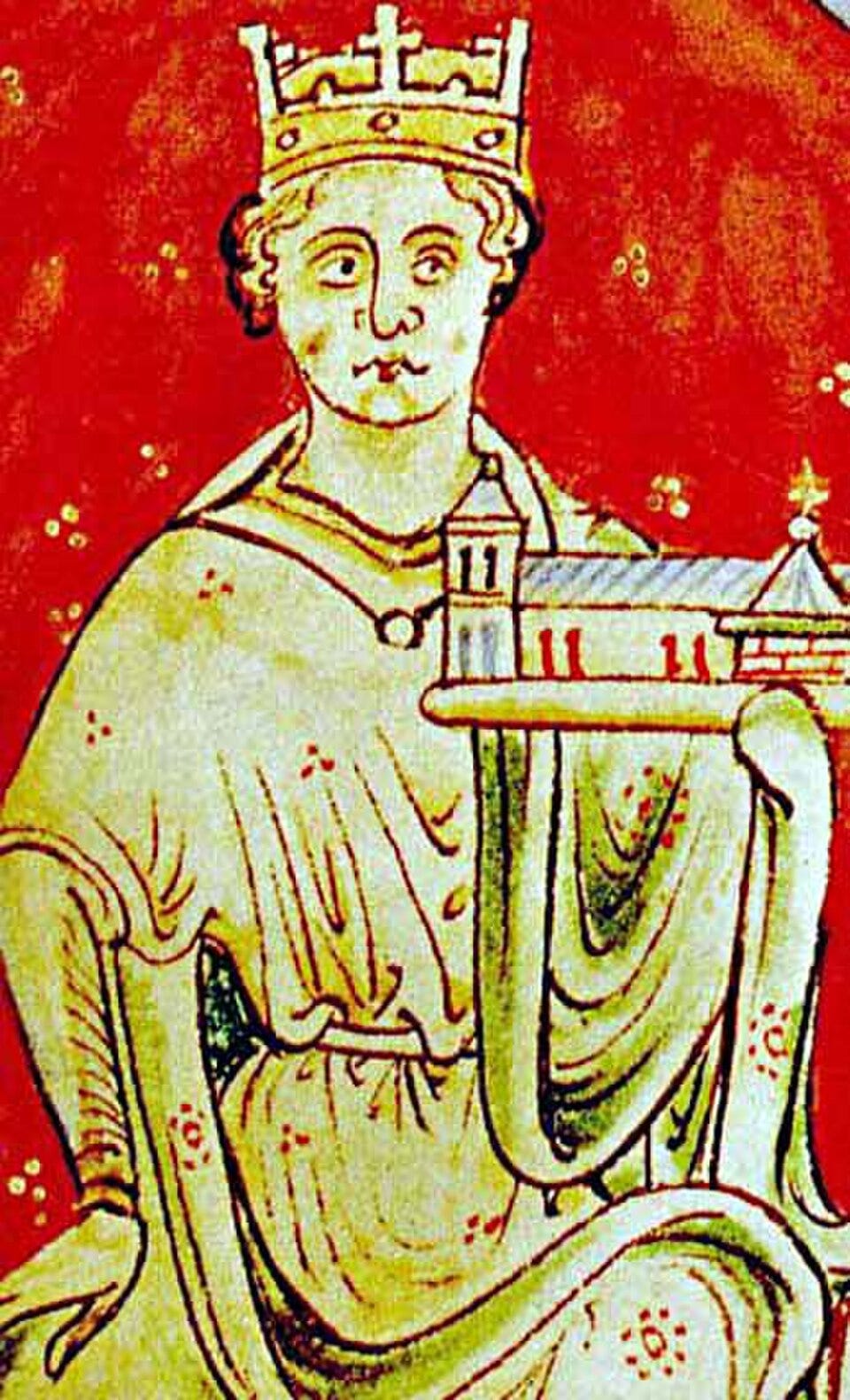
It was autumn in 1216. The Magna Carta had already been sealed by King John and then annulled by the pope at John’s request, and there was civil war in England. Some of the barons had invited Prince Louis of France to come for the throne; he held London at this point. John was marching around East Anglia and Lincolnshire. It was here that King John fell ill with dysentery, at King’s Lynn. Then came 12 October. King John and his army were at The Wash, a tidal area in the east of England. The tide came in and part of his baggage train got lost in the quicksand. Legend says that part of this lost baggage was actually the crown jewels; how much was actually lost is argued about among historians. Then, the king struggled on to the abbey at Swineshead, where he got worse. Roger of Wendover said that the king made himself worse (“he surfeited himself with peaches and drinking new cider”), while a much later story says that a monk of Swineshead poisoned the king.
King John struggled to the Bishop of Lincoln’s fortress at Newark. He died there sometime on the night of 18–19 October, with the abbot of Croxton (who was a “man well skilled in medicine”) looking after him. King John had asked to be buried near St Wulfstan at Worcester, not at Fontevraud with his parents and his brother, King Richard the Lionheart. His effigy at Worcester Cathedral is said to be the oldest royal effigy in England.
Everyone knows that King John was seriously disliked. Matthew Paris recorded a rhyme going around about him: “With John’s foul deeds England’s whole realm is stinking, / As doth hell, too, wherein he now is sinking.” Ouch.
At the king’s death, his heir was the 9 year old Henry of Winchester, later King Henry III. Half the kingdom was held by the French prince. More of this story on 28 October!
21 October 1422: Charles VI of France dies, and an English baby becomes king of France
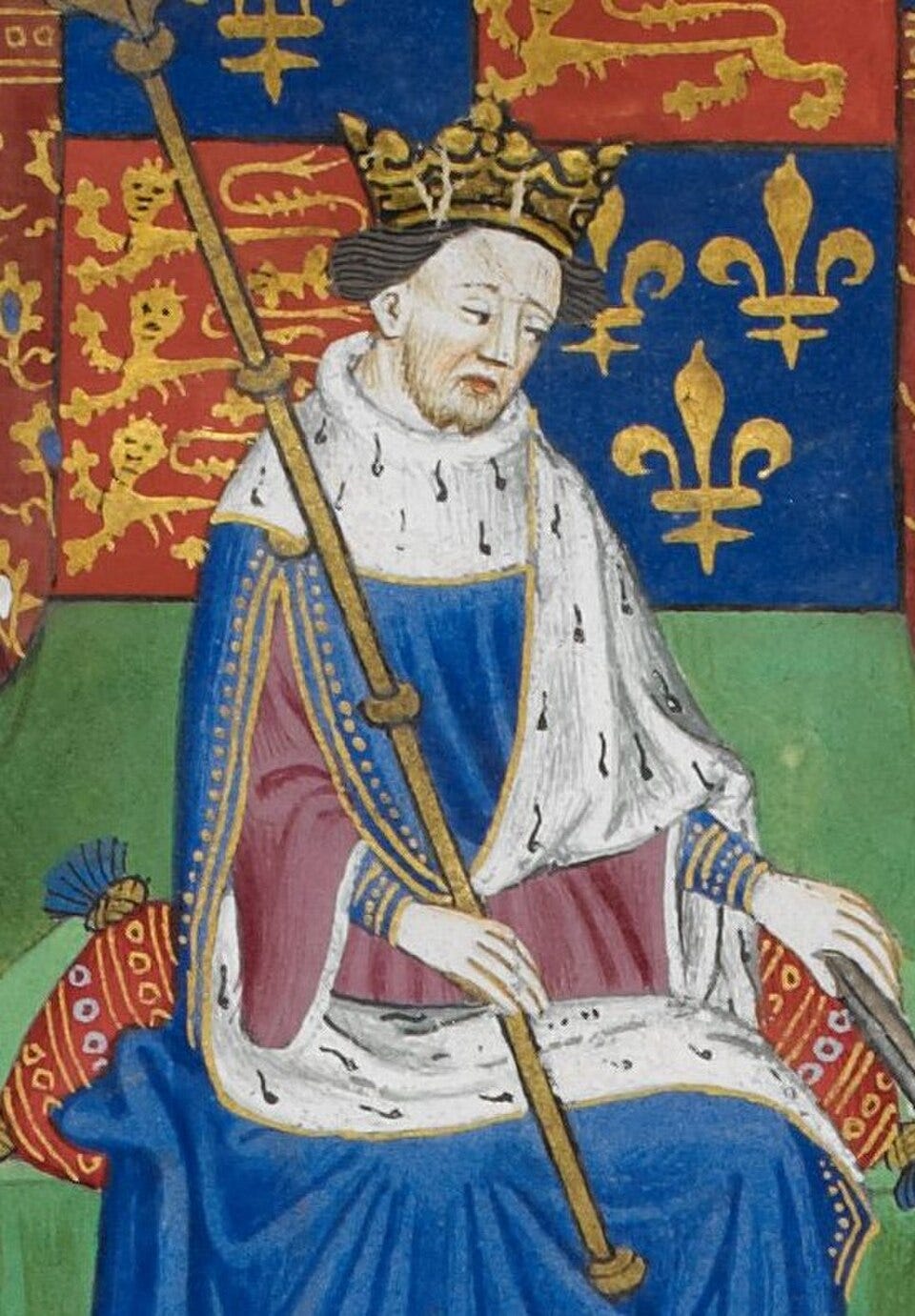
Back on 31 August 1422, Henry V died. His son, Henry of Windsor, Duke of Cornwall, who at the time was about nine months old, became King of England. Henry V, according to the Treaty of Troyes (1420) was heir to France. Because King Charles VI had been mentally ill for years, Henry V was also the regent. Therefore, after his death, baby Henry VI became heir to France instead. On his deathbed, Henry V had named his brother John, Duke of Bedford, to be regent of France.
Seven weeks after the death of Henry V, Charles VI, king of France, died at the Hôtel Saint-Pol in Paris from a fever. Therefore, the infant Henry VI of England became King of France. He was about ten and a half months old.
The funeral sounds like it would have been more somber than most. Not one French prince walked with the king’s casket. Usually, the dead king’s heir would be the chief mourner… however the king’s son, the Dauphin before the Treaty of Troyes, had been disinherited and was holding a rival court in Berry. The English Duke of Bedford, as the regent, stood as chief mourner. I can imagine that with the son having a rival court and the king having been severely mentally ill, the funeral was a bit lonely.
Some years later, when Henry VI was ten years old, he was crowned King of France in a ceremony in Paris on 16 December 1431. More on that in December!
I hope you enjoyed the first installment of this week’s On This Day round-up. Part two lands Friday: a peace treaty nobody kept, the end of the Anarchy, and Chaucer’s mysterious tomb!
And if you’re enjoying these stories, subscribe to Meg Loves History so you don’t miss the next one. 💛
Sources
The Anglo-Saxon Chronicle, trans. G. N. Garmonsway (Everyman, 1953)
The Anglo-Saxon Chronicle, trans. J. Ingram (1823)
Henry of Huntingdon, Historia Anglorum, trans. T. Forester (1853)
John of Worcester, Chronicle
Liber Eliensis, Book II
Roger of Wendover, Flowers of History, trans. J. A. Giles (1849)
Matthew Paris, Chronica Majora
Sidney Painter, The Reign of King John (1949)
Jonathan Sumption, Cursed Kings: The Hundred Years War IV (2015)
Images: Parker Library, Corpus Christi College, Cambridge, MS 26; British Library, Royal MS 14 C VII and Royal MS 15 E VI