Henry I is crowned King of England
This week in 1100: Count Henry is crowned King of England by the Bishop of London three days after the death of King William II
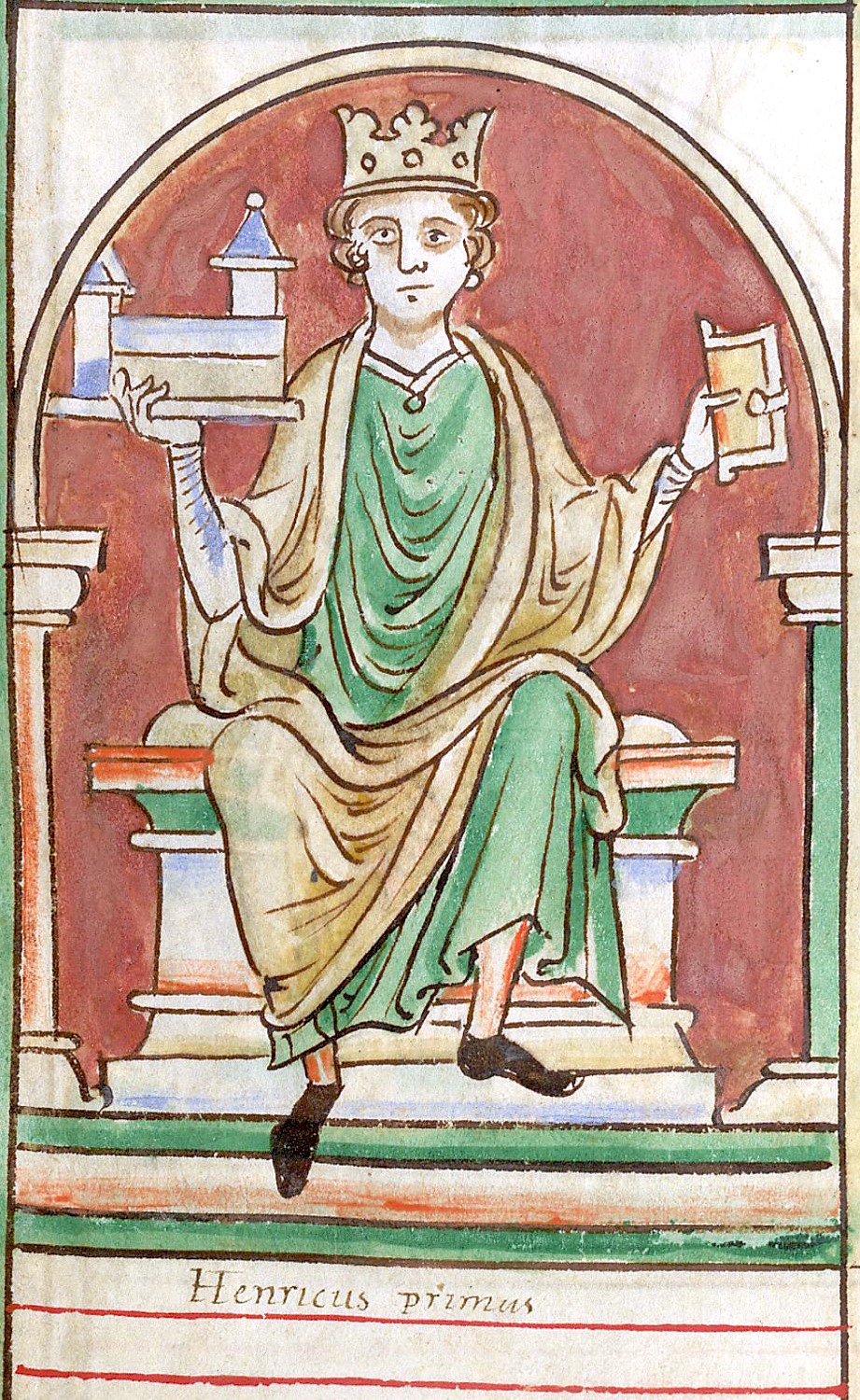
2 August 1100, Winchester
William II is dead. Immediately upon him being shot in the forest, the hunting party scattered, each man going to secure their own estates. Count Henry, his younger brother, rushed to secure the royal treasury at Winchester.
According to Orderic Vitalis, in Forester’s translation, Henry arrived at the treasury and demanded the keys from the keepers, as the lawful heir to the throne. A Norman magnate who was also in William Rufus’s hunting party, William de Breteuil, who seems to have anticipated what Henry was about to do, arrived breathless at that instant and resolved to oppose Henry:
“We ought,” he said, “to have a loyal regard for the fealty we have sworn to your brother Robert. He is, undoubtedly, the eldest son of King William, and both I and you, my lord Henry, have paid him homage. Therefore we ought to keep our engagements to him in all respects, whether he be absent or present. He has long laboured in God’s service, and the Lord now restores him, without a contest, the duchy which he relinquished for the love of heaven, as well as his father’s crown.”
Robert, Duke of Normandy, was on his way home from the Crusade (some sources say he was “close” while others place him in the Norman-ruled part of Italy, in the heel).
Keep in mind though, that all the people whose support Henry needed at this point had sworn fealty to Robert for their lands in Normandy. These oaths were owed to Robert even in his absence. They all had lands there and in England. They would be playing a dangerous game to make Henry king of England while their own lord had a claim (and maybe the same claim) to the crown. Supporting Henry over Robert meant risking all their Normandy lands, which is why this objection by Breteuil has some weight. Henry himself was the Count of the Cotentin, holding Domfront in western Normandy (and therefore Robert was his lord). Breteuil believed Robert had providence on his side… He had faithfully served God on Crusade, and now he was being restored to both crown and duchy (Robert had previously mortgaged Normandy to William Rufus in order to go on crusade). Now that he was coming home and William was dead, Normandy would come back to him without contest with England on top (at least that was Breteuil’s claim). Personally, I would assume others saw this providence as well.
At this point, on being initially denied what he wished, Henry drew his sword, and crowds gathered round to watch. The rest of the conversation isn’t recorded, but it seems like the crowd came around to the idea that Henry was present, in person, and Robert was not. The castle at Winchester and the royal treasures were then given up to Henry through the intervention of friends and counsellors, and no blood was shed. It is important to say at this point that Orderic Vitalis’s translator, Forester, notes here that Orderic is quite partial to Henry and further claims that Robert was “odious” to the clergy in general.
Four ways this was thought about
It is important to point out that there are a few different ways this was thought about:
When William I (the Conqueror) died, he left Normandy to Robert, England to William Rufus, and money to Henry. Robert had once been designated heir to both England and Normandy, but in his fury at Robert’s latest rebellion, on his deathbed William I left England to William Rufus.
Back in 1091, William Rufus and Duke Robert were allied. Hollister says that it was allegedly agreed that Robert would be William’s heir and William would be Robert’s heir, but he denies that the succession was decided by formal agreement. However, years later, when other parts of this treaty were ignored by William, at Christmas 1093 the whole treaty was thrown out by Robert. It can be argued therefore that when William died, Robert was not William’s designated heir. But, does that mean that William didn’t have a designated heir?
At this point in history, primogeniture was not the rule. Primogeniture is the belief that when a noble or king dies, the heir is the eldest son. According to Hollister, as of 1100, primogeniture had very rarely determined English royal succession. Consider William Rufus having an older brother, or Alfred the Great being the fourth brother to successively be king, the succession moving sideways instead of down.
Here are the two reasons that someone could claim that Henry had the better claim:
Robert was already “passed over” for being King of England by his father, William I.
Henry was “born in the purple”, meaning that he was born after William I was king. This made a difference to a lot of people for having the noble blood in order to be a king. This is called “porphyrogeniture”. It is not a conclusive way to say who is the heir, but, according to Hollister, it’s perhaps even less conclusive than primogeniture.
3 August 1100, Winchester
William II was buried on this day. We went over that in last week’s piece.
Also on 3 August, Henry was “elected” to become king. This wasn’t an election like what one would think of today, even if it is talked about as if “the people” elected him to the crown. These elections were generally quite informal and not representative at all, and, Hollister says, Henry’s was “neither better nor worse than most”. Therefore, any nobles who were near at hand at that moment were appealed to. Personally, I would assume that just the nobles nearby were sought out because Henry seemed to be in a great hurry… Remember that Rufus was buried in less than 24 hours from his death, and Henry was seeking an election on the same day as the funeral. These magnates came together and decided that Henry should be king. This election is one of three things needed at this time to become a king, along with the actual anointing and coronation. So, even if it was highly informal, it was an extremely important part of the story.
After the election took place, Henry installed a man named William Giffard to be the Bishop of Winchester, as this was the wealthiest vacancy that Rufus had left. The Anglo-Saxon Chronicle says that Rufus, when a see fell open, would either sell it for money or keep it within his own grasp and let it for rent; he claimed to be “the heir of every man, cleric or lay”. Giffard, most importantly, had been Rufus’s chancellor. Also, note that this was two days before Henry’s charter in which he promised not to take from a vacant church.
4 August 1100, on the road
Hollister says that very soon after the election, Henry left Winchester, along with Robert, Count of Meulan. Robert was the older and “shrewder” of the Beaumont brothers. Hollister believes that Henry made the seventy-mile trip from Winchester to Westminster in one day, having travelled light. He arrived on Saturday 4 August with plenty of time to prep for a traditional Sunday coronation. Hollister also believes that Henry’s coronation charter, which we will talk about below, was drafted with Meulan’s help in the course of this journey. Meulan had been an intimate counselor of Rufus’s and therefore at his side when several of the policies denounced in the document were made.
5 August 1100, Westminster: the coronation
Count Henry was crowned Henry I of England by Maurice, Bishop of London. He was not crowned, as was traditional, by the Archbishop of Canterbury, Anselm. Anselm was in exile following a rift with Rufus, and the Archbishop of York was infirm and not at hand. Maurice, Bishop of London, was an acceptable substitute for Anselm for a few reasons:
Maurice was ex officio vicar and senior suffragan of the Archbishop of Canterbury, meaning he was not only a bishop under the Archbishop’s authority but he was the man who acted for Canterbury when the Archbishop couldn’t act. Therefore, he was Anselm’s deputy standing in for him in his absence.
Maurice was the highest ranking prelate available. Anselm was exiled in France. Thomas of York was old, infirm, and at Ripon; he was too far away to make it in time for a swift coronation.
Using Maurice would be the least offensive option to explain to Anselm later; if Henry had waited for Thomas, Archbishop of York, Anselm more than likely would have been offended, since York and Canterbury had a long-running fight over primacy.
The validity of the ceremony didn’t depend on who performed it. Once the king was properly anointed and crowned he became a consecrated rex, which couldn’t easily be undone.
However, Maurice had never done this ceremony. According to Hollister, more than likely he had not received the news of Rufus’s death before 4 August.
The rite
Every coronation followed what was basically a written script. It laid out what was said, what was done, and in what order; however, there was more than one version in circulation. Bishop Maurice seems to have used the one most readily at hand, because the whole thing had been put together in a hurry and could not be postponed. That order of service seems to have been the work of Archbishop Ealdred of York, adapted from a German one he came across while visiting Cologne in the 1050s. Ealdred used it to crown Harold Godwinson and then William the Conqueror in 1066, and Lanfranc probably used it for Rufus in 1087. So the service Henry was hurried through was the same one that had made his father king. (It’s called the Third English Ordo, if you want to look it up. Ordo is just Latin for order, as in order of service.)
The promise
He stood before the altar and made the required “threefold promise”: to keep the peace, to prohibit all robbery and unfairness, and to keep just laws as well as the kings before him had. Henry didn’t leave it there. Men about to be crowned sometimes changed the wording, and so Henry expanded the second of the three by promising to correct all the injustices of his brother’s reign.
The Chronicle has the same thing from a contemporary, and it gives the order:
On the following Sunday, before the altar at Westminster, he vowed to God and all the people to abolish all the injustices which were prevalent during his brother’s reign, and to maintain the best laws which had stood in the time of any of his predecessors. Thereafter Maurice, the bishop of London, consecrated him king…
The vow came first. Then the consecration. Hold onto that, because it matters when we get to the charter.
Next, Maurice turned to the magnates, bishops, and officials in the abbey and asked whether they would accept Henry as their king. They agreed. Hollister says this firmly seconded “the rather casual election at Winchester”. Two days earlier, a handful of nobles who happened to be nearby had picked him. Now a full room said yes.
The anointing
Then the bishop anointed him, and it was not just a little dab. Hollister lists it: the upper parts of his body were anointed with the blessed oil, his hands, breast, shoulders, elbows, and head. Then his head was anointed a second time, with sacred chrism.
This is the part of the service that did the work, so it is worth asking why oil.
The answer is in Scripture. The Bible describes the anointing with oil of Saul (1 Samuel 10:1), David (1 Samuel 16:13), and Solomon (1 Kings 1:39). I would believe that the people standing in the abbey would have remembered these verses.
Hollister puts the belief plainly. Once someone was properly anointed and crowned he was “transformed from a mere mortal into a consecrated rex, God’s anointed one — a symbol, as many believed, of Christ on earth”, and it was next to impossible to take that away from someone.
The words themselves carry it. Hollister’s footnote quotes Kantorowicz: Christ was king and Christus by his very nature, while his deputy on earth was king and christus by grace only. Christus is simply the Greek for anointed one, which is what messiah means in Hebrew. The vocabulary of the ceremony and the vocabulary of Scripture match up.
The rest of it
After the oil came the regalia. Maurice presented the royal sword, the armlet, and a pallium (more of a cloak, not the archbishop’s pallium that Anselm and Rufus had quarreled over). He blessed the crown and placed it on Henry’s head with a prayer, then invested him with the ring, staff, and scepter. Benedictions, the kiss of peace, the Te Deum, and Henry was enthroned. Mass was celebrated while he sat there, and at the end of it the new king received the Eucharist (communion).
Then, in the Chronicle’s words, “all the people in this land submitted to him and swore him oaths of allegiance, and became his men.”
Anselm, when he came back to England in early autumn, accepted the coronation upon meeting King Henry. According to Eadmer, they met in Salisbury a few days after the Archbishop’s return. The king excused himself at this point for having been consecrated without waiting for Anselm, whose “special right” he knew it was to do the anointing. Anselm accepted the king’s reasoning.
5 August 1100, Westminster: the charter
On the same day as the coronation, King Henry presented his coronation charter. He had his promises copied in writing (which is something that happened for the first time) and sent throughout England. We have the copy sent to Worcestershire. It starts like this:
Henry, king of the English, to Samson the bishop, and Urse of Abbetot, and to all his barons and faithful vassals, both French and English, in Worcestershire, greeting.
Normally, charters were addressed first to the leading churchman, to the sheriff, and then to the landowners. We can assume that Samson was the Bishop of Worcester; presumably, Urse of Abbetot was the sheriff of that shire.
Clause 1 was, in my opinion, the most important:
Know that by the mercy of God and by the common counsel of the barons of the whole kingdom of England I have been crowned king of this realm. And because the kingdom has been oppressed by unjust exactions, I now, being moved by reverence towards God and by the love I bear you all, make free the Church of God; so that I will neither sell nor lease its property; nor on the death of an archbishop or a bishop or an abbot will I take anything from the demesne of the Church or from its vassals during the period which elapses before a successor is installed. I abolish all the evil customs by which the kingdom of England has been unjustly oppressed. Some of those evil customs are here set forth.
Henry at the very beginning of his charter promised not to do one of the most hated things of his brother’s reign: money-grubbing from the Church. The rest of the charter was relatively brief, with 13 more clauses. These promises covered things like inheritances, widows and marriage, debts, coinage, murder-fines, the forest, and the general return to the law of King Edward. The promises were confirmed by Henry with an oath and published throughout the kingdom. This is the first time the king’s coronation charter was put on parchment for people to read and hold onto, and that’s why I think the charter matters much more than the coronation oath did.
About the clause about King Edward, number 13:
I restore to you the law of King Edward together with such emendations to it as my father made with the counsel of his barons.
This is referring to Edward the Confessor, whose death directly led to William of Normandy becoming William the Conqueror. Edward was king of England until 1066, the last of the old royal line. “The law of King Edward” simply meant the law of the land before 1066; Henry was promising to restore the laws to how they were before the Norman Conquest, plus the changes his father made. Many English kings of the era used this phrase in order to look more legitimate.
What followed
Soon after his promises were made, on the advice of his counselors, Henry had Rannulf, bishop of Durham, arrested and brought to the Tower of London. Rannulf had been a main advisor of Rufus.
Within days of the coronation, Henry also wrote to Anselm, requesting his return to England as Archbishop of Canterbury and advisor to the king. Before Michaelmas (29 September), Anselm indeed returned to England. He had gone into exile because of Rufus’s injustices towards him.
Who was the rightful heir?
The question that came up during my research for this week was, was Henry the rightful heir or was he a usurper to his brother Robert’s crown? From what I understand throughout the sources, William Rufus didn’t have a designated heir. If Robert had indeed been his heir earlier during the 1093 treaty, that treaty was thrown out long before Rufus’s death. Rufus had no sons, so therefore if primogeniture was the rule at this point in history (it wasn’t), Robert would have been the heir as the older male relative. The whole “born in the purple” thing wasn’t unheard of but it also wasn’t the rule. The only sure thing was the election. If you think back to Anglo-Saxon times, from what I remember kings were elected/confirmed by the Witenagemot, even if it usually was a family member of the last king. Henry’s “election” by the available nobles in Winchester was the same idea. Robert wasn’t there to assert his rights as a possible heir... it was unfortunate for him, but really there was no argument if the nobles elected Henry. Once Henry was consecrated, he was the king, no contest. He was able to secure a coronation first, so, in my opinion, he was the rightful king. I understand the hesitation from the outset though... most if not all of the nobles were liegemen to Robert for their lands in Normandy, so they probably should have waited for him. Also, Robert was on his way back from Crusade, which put him even more in a position for consideration.
What do you think? Was Henry right to rush to get crowned, or should everyone have waited for Robert?
Sources
The Anglo-Saxon Chronicle, translated by G. N. Garmonsway. Entry for 1100.
Orderic Vitalis, The Ecclesiastical History of England and Normandy, translated by Thomas Forester, Bohn’s Antiquarian Library, vol. III (1854). Book X. Forester’s editorial notes are his own, not Orderic’s.
Henry I’s coronation charter, in English Historical Documents 1042–1189, edited by David C. Douglas and George W. Greenaway, no. 19, pp. 400–402.
Eadmer, Historia Novorum in Anglia, translated by Geoffrey Bosanquet as Eadmer’s History of Recent Events in England (1964).
The Letters of Saint Anselm of Canterbury, translated by Walter Fröhlich, vol. 2, Cistercian Publications (1993).
C. Warren Hollister, Henry I, Yale English Monarchs.
Ernst Kantorowicz, The King’s Two Bodies, quoted in Hollister.
The Bible, NASB 2020. 1 Samuel 10:1, 1 Samuel 16:13, 1 Kings 1:39.