On Friday, 12 July 1174, Henry II did public penance at Canterbury for the murder of Thomas Becket, the Archbishop of Canterbury who had once been his closest friend. He had already been absolved for it by the Church two years earlier. He did it anyway.
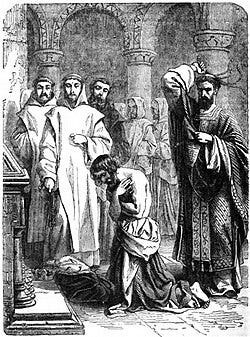
Henry II doing penance at the tomb of Thomas Becket. Wood engraving from Cassell's Illustrated History of England (19th century). Public domain, via Wikimedia Commons.
He was the King of England, but he was also a lot more than that. His lands ran from the border with Scotland all the way down to the Pyrenees, the mountains between France and Spain. He held England, and he held the whole western half of France, which was more of France than the King of France actually held himself. On paper, Henry owed homage to King Louis for those French lands, as a vassal would owe his lord, but in reality Henry was the far more powerful man.
He was also a forceful man, restless and physically strong, remembered by those who knew him as someone always in motion and not easily crossed. He was not the kind of man who humbled himself for anyone.
And yet he walked the last stretch into Canterbury barefoot, through the mud, so that the whole city would see him do it.
To understand why, and to understand why he was doing it a second time, we have to go back a bit.
The friendship that broke
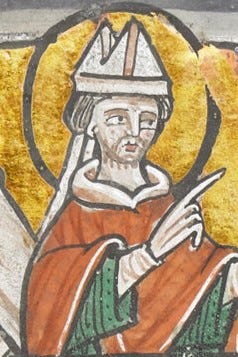
Thomas Becket, Archbishop of Canterbury, in a manuscript made around 1180, within about ten years of his murder. British Library, Cotton MS Claudius B II, f. 341r. Public domain, via Wikimedia Commons.
Thomas Becket had been Henry’s chancellor and close friend. When Henry made him Archbishop of Canterbury in 1162, he expected to have his own man running the English Church. He didn’t get that at all... Becket almost immediately resigned the chancellorship and took the Church’s side against the crown. Their friendship turned into a long and bitter fight over who held what power. There were several failed attempts to make peace. Becket spent years in exile in France and came back in late 1170 with the quarrel still very much unresolved.
Then, at his Christmas court in Normandy in 1170, Henry lost his temper.
The famous line, “will no one rid me of this turbulent priest”, is not his. It was invented by a bookseller in 1740. The earliest report of what he really said comes from Edward Grim, who wrote a life of Becket not long after the murder. Grim gives it in Latin, and it comes out roughly as this: “What miserable drones and traitors have I nourished and promoted in my household, who let their lord be treated with such shameful contempt by a low-born clerk!”
This was not an order. Henry doesn’t tell anyone to do anything. He complains about his own men, that they’re disloyal, having let a low-born churchman humiliate him. But Grim wasn’t even in the room; he was at Canterbury. This is a report of a rage that reached him, not something he witnessed.
However, four men did take it as an order. They heard it, or heard about it, and rode for Canterbury. On 29 December 1170 they killed Thomas Becket in his own cathedral. It was seriously gruesome. Grim was there for the murder, and nearly lost his arm shielding Becket.
That is as much of the murder as this piece needs. If you want the full story of the quarrel, the exile, and the killing, John Guy’s Thomas Becket: Warrior, Priest, Rebel is the book I would point you to, and it covers the whole fight over the Constitutions of Clarendon (Henry’s attempt to bring the English Church under royal law) far better than I could in a paragraph.
The part I missed
Here is the thing that surprised me most when I started reading for this piece: this wasn’t the first time Henry had done public penance over Becket’s death. It was the second.
In May 1172, at Avranches in Normandy, Henry had already gone through this. William of Newburgh (an independent churchman in Yorkshire, with no ties to Canterbury or the court), writing about twenty years later, describes it plainly: Henry cast off his clothes “after the custom of public penitents” and “submitted himself naked to ecclesiastical discipline”. The cardinals were “overjoyed at the humility of so great a prince, and weeping with joy”. He was absolved by the Church. He swore he had not ordered the murder, only that some words of his, “too incautiously uttered”, might have given the killers their occasion.
So Henry was beaten, and absolved, in 1172.
Which leaves an obvious question. If the Church had already forgiven him two years earlier, why was he barefoot in the rain at St Dunstan’s in 1174?
Absolution is not the same as satisfaction
The answer, I think, is a distinction that a medieval Christian would have understood at once, and one we tend to miss today.
The medieval Church broke repentance into parts. There were three:
Contrition. You had to be truly sorry for the sin.
Confession and absolution. You confessed to a priest, and the priest, acting for God, absolved you. This lifted the guilt. Your soul was no longer condemned for the sin.
Satisfaction. Being cleared of the guilt did not cancel what you owed. There was still a debt to be paid for the wrong itself, and you paid it by doing penance: fasting, giving to the poor, going on pilgrimage, submitting to a beating.
These are two different things, and the difference is the whole point. Absolution dealt with the guilt: the sin that condemned your soul. God took that away through the priest, fully and at once. But a forgiven sin still left a debt of punishment owed, and that debt did not vanish just because the guilt was gone. You could be completely forgiven and still owe. Absolution was God’s to give. Satisfaction was yours to pay.
In practice this wasn’t always so tidy. Sometimes the penance came before the absolution, sometimes after, and being absolved didn’t always mean the whole debt was paid off.
So Avranches wasn’t a failure, and I don’t think it was a piece of theatre either. It was genuine. Henry had been forgiven in 1172; he had just not finished paying.
And by the summer of 1174, the bill had come due.
Why now
By 1174 Henry’s world was coming apart, and quickly:
His sons were in open revolt against him. The eldest, also called Henry, along with Richard and Geoffrey, had taken up arms.
His wife, Eleanor of Aquitaine, had backed the sons against him. He had her in captivity.
Louis VII of France was supporting the rebels.
A Flemish invasion force was expected to land in England.
William the Lion, King of Scots, had invaded the north.
Becket, meanwhile, had been made a saint in February 1173, a little over two years after his death. The miracles at his tomb were multiplying, and pilgrims were already coming. Becket was now a saint, and Henry was losing.
He landed at Southampton on 8 July 1174, having sailed from Barfleur, and reached Canterbury four days later, on the twelfth. He went before he turned to fight the invasion. The war could wait. Canterbury could not.
The walk
He came at Canterbury from the west, along the London road. And here the sequence of what he did is very deliberate, so I want to lay it out in order.
First, he stopped at Harbledown, just outside the city, at the hospital of St Nicholas. This was a leper hospital, founded by Archbishop Lanfranc about ninety years before, and it had its own chapel. It’s all still there today. Henry dismounted, prayed in the chapel, and granted the lepers twenty marks a year, paid out of the tax Canterbury owed the crown. (That grant has never stopped. It comes to £13.33 now, and it has been paid for over 850 years.)
Then, he rode the short distance to St Dunstan’s, the first church you meet coming into Canterbury from the London side. And there, as I said at the start, he took off his shoes and his outer clothes, and went barefoot from that point on. It had been raining hard. He had worn a hunting cloak over his shirt to get that far, and now he gave that up too.
From St Dunstan’s, he walked barefoot through the Westgate and into the city. It’s only about a quarter mile to the gate. Then, he continued on through the streets. He could have ridden to the cathedral door in a few minutes. The walk was short, and public, and slow, and that was the entire idea. Half of Canterbury could line the streets and watch their king come in barefoot in the mud.
Gervase of Canterbury, a monk of the cathedral who had actually buried Becket, describes it simply: Henry “walked barefoot and clad in a woollen smock all the way to the martyr’s tomb”. Not sackcloth and ashes, which is the phrase that always wants to attach itself to a scene like this. A woollen smock: poor man’s clothes, not a costume. He was dressed plainly, not theatrically, and I think the difference is the point.
The tomb
When he reached the cathedral, he didn’t go immediately to the tomb. Instead, he went to the spot in the north transept where the knights had cut Becket down. He kissed the stones of the floor where it happened. Then, he went down into the crypt, where the body lay.
There, he reached the tomb. Shrine-tombs like Becket’s had apertures, gaps in the stonework, so that pilgrims could get their heads and hands close to the holy body inside. A pilgrim would kneel beside it and reach in. Henry put his head and shoulders right into the openings.
What happened after that survives in more than one account, but they don’t all place it in the same room. One account, in the Materials for the History of Thomas Becket, keeps the scene at the tomb. William of Newburgh instead puts it in the chapter house, where Henry prostrated himself and entreated pardon. The accounts differ on the room, but they agree on what was done to him.
Henry was beaten. He asked for it as part of the penance, and the bishops and monks present gave it to him. The Materials account gives the numbers: five strokes from each of the bishops, and three from each of the monks, and there were around eighty of them. Gervase says he “of his free will was whipped by all the bishops and abbots there present and each individual monk of the church of Canterbury”.
He then made an offering to the martyr. The sources give a figure, but I couldn’t trace it back to anything trustworthy, so I’ll leave that out. He gave back the lands and rights he had seized from the Church during the quarrel. He gave up his grievances against everyone who had taken Becket’s side against him.
Then, he spent the whole night on the bare ground of the crypt, with the mud from the road still on his feet.
Did anyone think he was faking?
I really wanted an answer to this question, and I think the answer is no. None of the contemporaries I could find seemed to doubt it was genuine.
That matters, because the people reporting it weren’t on the same side. They had different loyalties and different reasons for writing.
Gervase was a Canterbury monk. His house owned the shrine and had every reason to want the story told well. Fine. You might discount him.
But William of Newburgh, up in Yorkshire, had no shrine to sell and no king to flatter, and he’s the man who elsewhere called Geoffrey of Monmouth a shameless liar, in writing, at a time when everyone else took Geoffrey’s tales of King Arthur for real history. He isn’t a man who believed things easily. He had no doubt at all that what happened at Canterbury was genuine and that it worked.
That’s worth holding onto, because of how this scene often gets remembered. Later writers, especially after the Reformation, liked to picture Henry being whipped on the pope’s orders, the crown humbled by Rome. One English engraving even titled the scene “K. Hen. 2. whipt by the Popes Order”. But that isn’t how the men who were closest to it saw it. Not one of them frames this as Henry submitting to the Church. They frame it as a debt paid to Becket.
What the penance was
So here’s what I think this was, and it’s the whole reason the distinction earlier matters.
This wasn’t Henry submitting to the Church. The Church, as an institution, is barely in the story. There’s no pope in the crypt, no papal legate cracking a whip, no surrender of royal rights to Rome. The bishops and the monks are holding the rods, yes, but they aren’t the ones being satisfied.
The transaction is with God, not with the Church. The monks are instruments. Becket is the intercessor, the saint in heaven who might be persuaded to take Henry’s side. And what Henry is doing is paying a debt he had been carrying since 1170. He was absolved at Avranches. The debt was still unpaid. Now, with his sons and his wife and two kings and a saint all against him, he paid it in the one way he had left: with his own body.
I’ll keep my own religious views out of this. On the theology of whether a dead man can really be satisfied this way, I’m holding off. What I can say is that Henry believed it was worth doing, and that everyone who watched believed it too. In their world, a debt to a saint was as real as a debt to a living lord, and you paid it the same way: publicly, and in a form everyone could see.
What happened next
Henry left Canterbury on 13 July and went to London, worn down. Then he waited.
What he didn’t know was that things had already turned. The way he found out is my favourite passage in any of the sources for this whole episode, so I’m going to let Newburgh tell most of it.
In the middle of the night, a messenger came hammering at the gate of the king’s lodging. The guards told him to be quiet and go away. He knocked louder. He said he had news the king had to hear that night, and he would not be put off. Soon enough, because they half-hoped he was bringing good news, they let him through. He talked his way past the guards, past the chamberlains, all the way to the king’s bed, and woke him up.
The king, on awaking, said, “Who art thou?”
“I am the attendant upon Ralph de Glanville, your faithful liegeman... I come to bring good tidings.”
“Ralph, our friend! Is he well?”
“He is well, my lord; and, behold, he holds your enemy the king of Scots, captive in chains at Richmond.”
Ralph de Glanville was the commander who had captured William the Lion at Alnwick. If you read Part I, you’ll know him. The invasion from the north was over. It had happened, as far as anyone could tell, on the very morning after the penance.
And here’s the part I love. Henry doesn’t believe it. His answer is two words: “Say on.” Tell me again. The messenger repeats himself, because he has nothing to add, and Henry, still not satisfied, asks: “Have you no letters?” It isn’t enough for a man to stand there and say it. He wants it in writing, under seal. Only when the sealed letters are in his hands does he leap out of bed, weeping, and wake the whole household to tell them.
Newburgh adds one last touch. Other messengers arrived in the morning with the same news. But only the first one, the one who knocked louder, got the reward.
Then, the bells rang out all across London.
Paid in Full
For William of Newburgh, there was no question about what had happened. The capture came the next morning, but Newburgh puts it on the same day as the penance, “as it is said, at that very hour”. God had timed it deliberately, he thought, so that the reward would not merely follow the penance but arrive alongside it, “so that no man might be suffered to be in suspense on this point”. The message was meant to be unmissable. Henry humbled himself before the martyr, and within a day his greatest enemy was in chains.
The one person you might expect to have doubted the miracle never did. William the Lion, the man actually captured that morning, could have put it all down to bad luck or to being surprised in the fog with his men scattered. He did not. In 1178, he founded a great abbey at Arbroath. He dedicated it to St Thomas Becket, the very saint whose intercession had handed him over in chains. He spent the rest of his reign endowing it. The man on the losing end of the miracle believed in it too, and paid for the privilege.
So did it work? To Henry’s contemporaries, yes. Henry had a debt, and he paid it, barefoot and bleeding, on his knees, whipped by the monks. And the man he had been fighting founded an abbey to say the same thing.
Absolved in 1172. Paid in full in 1174.
What do you think? Let me know in the comments below!