On This Day, 28–30 September
Tinchebray, Michaelmas, and the fall of Richard II
I’m splitting this week’s On This Day round-up into two posts. For the first half of this week, we have two family feuds with an important feast day in between.
I hope you enjoy! If you do, please let me know in the comments at the end of the post, and please subscribe if you haven’t already
On 28 September in 1106, Robert Curthose, William the Conqueror’s eldest son and a returning crusader, lost the Battle of Tinchebray to his youngest brother, Henry I of England.
Robert had pawned Normandy to his other brother, William Rufus, for 10,000 marks to go on the First Crusade, and he helped take Jerusalem in 1099. He came home in 1100 to find Rufus dead and Henry already crowned (I wrote about how Henry pulled that off here: Henry I is crowned King of England). Robert got Normandy back without repaying the loan, but he was too late for England, which he viewed as his birthright.
After a first round of fighting over England in 1101, Robert gave up his claim for a pension. Five years later, Henry came to conquer Normandy. Their cousin and Robert’s main ally, William, count of Mortain, held a castle at Tinchebray, a small town in southwest Normandy, and Henry was besieging it. Robert went to help and ended up getting captured after a short battle; he lost Normandy while trying to protect his cousin’s castle.
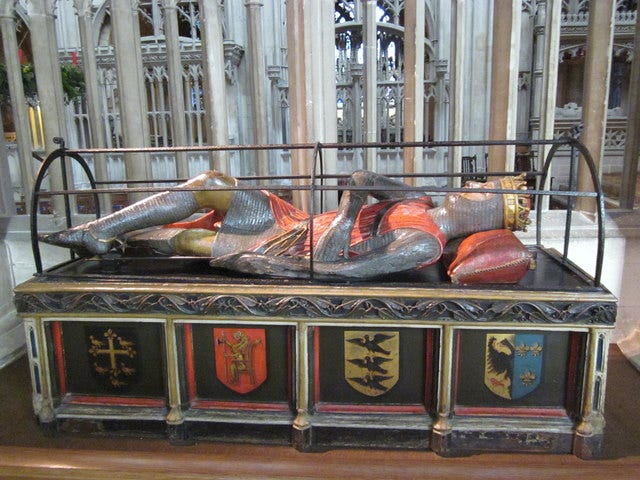
Henry kept Robert prisoner, first at Devizes and then Cardiff, until he died in 1134 at about 80, after nearly 28 years as his brother’s captive. He’s buried in Gloucester Cathedral, where his effigy still survives.
I like how Orderic Vitalis referenced the battle: “brothers and kinsmen were arrayed on different sides”… the whole thing really was a sort of civil war. Orderic even calls it “worse than a civil war”.
Honestly, I don’t think my sister would imprison me for the rest of my life over anything short of murder or something, but times were different then. This was politics, and in a lot of similarly political scenarios of this era, familial ties didn’t seem to matter all that much. Would I forgive her? I mean as a Christian I would have to learn to, but it certainly would be extremely hard! Henry cited the idea that Robert wasn’t treating Normandy well, that he was basically too weak to keep order and that his barons were preying on the church and the poor. That was his casus belli… I have no idea if Robert was a bad ruler, but especially if he wasn’t, this wasn’t an easily forgivable thing!
29 September in the medieval church calendar is the Feast of St Michael, also known as Michaelmas. But what is it?
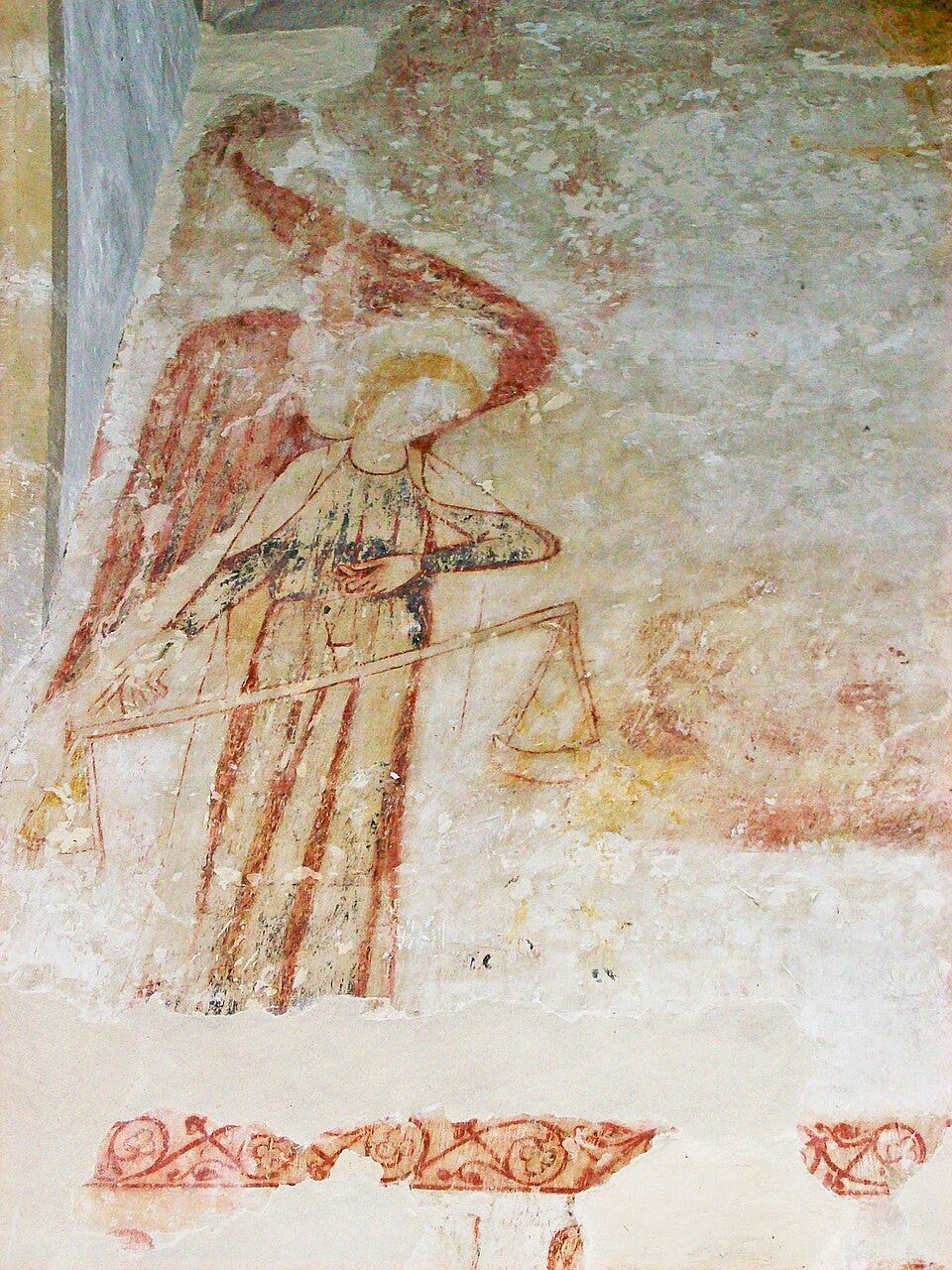
In medieval churches, St Michael the Archangel was shown weighing souls at the Last Judgement as well as fighting the dragon in Revelation 12.
Outside the Church, it was one of England’s four quarter days (the others are Lady Day, Midsummer, and Christmas). On quarter days, rents were due, contracts began (so people would hire servants etc), and debts were settled.
The king’s fiscal year ran from Michaelmas to Michaelmas; therefore, the sheriffs came to the Exchequer to account for the king’s income from their county: rents from his lands, court fines, and other dues. All this information was written in the Pipe Rolls, the earliest surviving of which is from 1130, under Henry I, the same Henry from the Tinchebray story above.
In the church service for the celebration of Michaelmas, the congregation heard the story about what led to the founding of St Michael’s shrine on Monte Gargano in southern Italy, which involves a runaway bull, a poisoned arrow that turned back and killed the shooter, a fasting bishop, and the archangel St Michael claiming guardianship over the area. Later in the story, St Michael helped the Christians win a battle, and they found “as it were a man’s footsteps [presumably St Michael’s] firmly impressed on the stone.”
The sermon would have also included guardian angels. In Ælfric’s Michaelmas homily, written in Old English in the late 900s, he says, “It is a great honour for Christian men, that every one has from his birth an angel assigned to him in fellowship.” He finishes by saying that St Michael is “the constant supporter of Christian men on earth, and their intercessor in heaven”.
So basically, for the Church celebration, there was a mass and communion, including a sermon that told a miracle story and a promise that every Christian had their own guardian angel. For a farming congregation that just paid its (probably hefty) rents, I’m sure it was a welcome message.
I’m studying Bible and Theology at university. While I am no longer Catholic, I understand that for people at the time, this teaching was every bit as true as the Bible, especially as it connected to it in several ways (Matthew 18:10, Psalm 91, and Acts 12, to name a few). I’d never heard of people having a guardian angel, other than as something we tell children.
On 30 September 1399, a king became a simple knight.
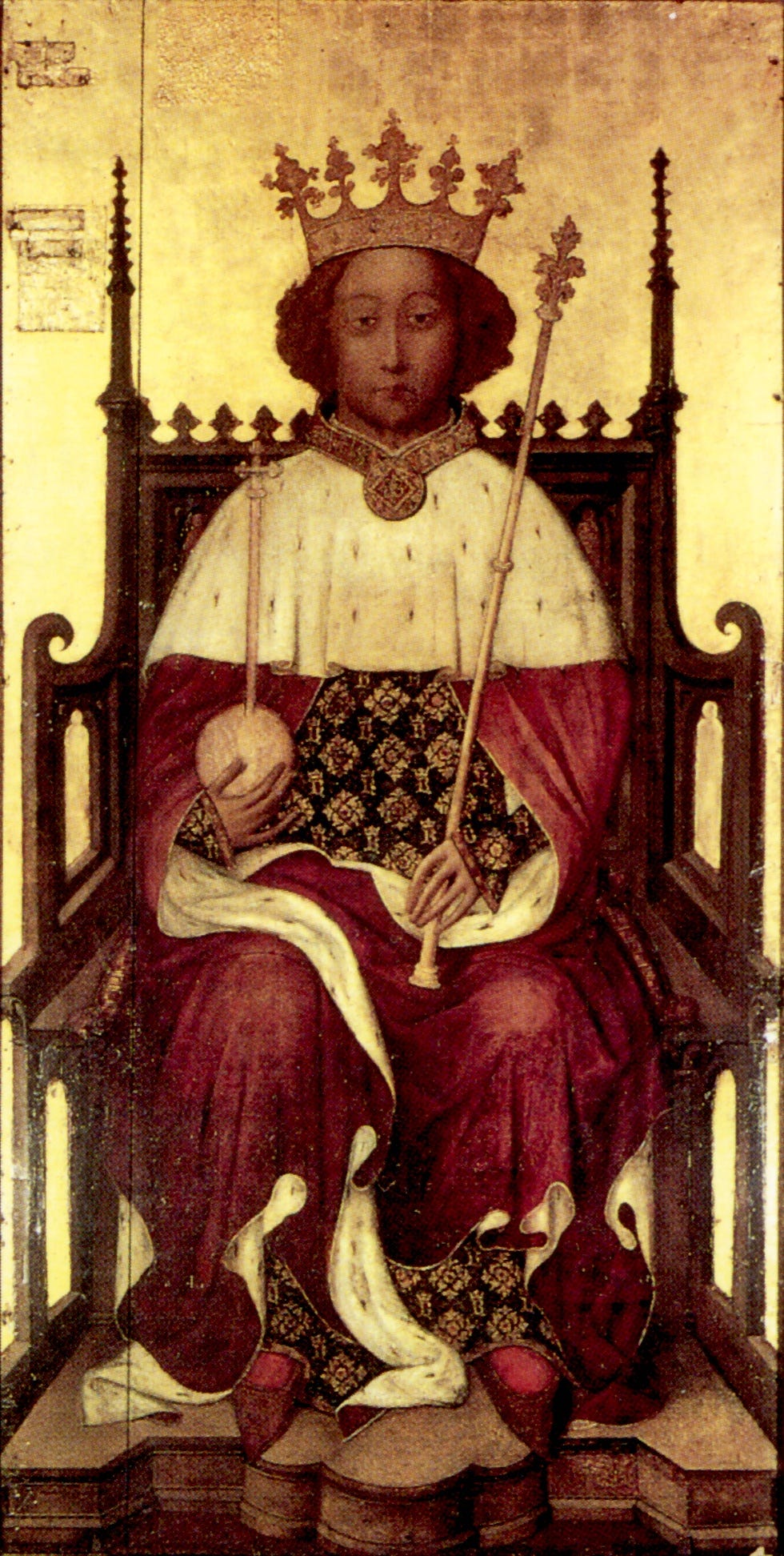
Here’s the story. It was August 1399. Richard II, king of England and grandson of Edward III, was captured after being lured out of Conwy Castle (in Wales) by the Earl of Northumberland, acting for Richard’s cousin, Henry Bolingbroke, the disinherited Duke of Lancaster and another grandson of Edward III. Richard was brought to London and put in the Tower.
Fast forward to the 29 of September. The official record says that Richard agreed to give up the crown… some sources say it wasn’t given up willingly.
Then, on 30 September, Parliament gathered at Westminster Hall, but without the king. The lords officially renounced their loyalty to Richard and declared him “not for king, but for a private person, Sir Richard of Bordeaux, a simple knight.” They took his ring and gave it to Henry of Bolingbroke, who (and this is super important to history) was not next in line to the throne. They had the Archbishop of York read Richard’s surrender out loud, “as though the king himself were speaking.” Then, with the throne being now vacant, Henry of Bolingbroke sat on the throne and claimed the crown by descent from Henry III.
Did you notice he didn’t say by descent from Edward III, the grandfather of both him and of Richard II? And you remember how I said he wasn’t next in line? The person who had the better claim was a descendant of Edward III’s second son, named Edmund Mortimer, Earl of March. The problem was that Edmund Mortimer was seven years old and didn’t have the army and the lords backing him. Later on, Henry Bolingbroke claiming the throne is going to be a problem, and here is why:
Richard II was the son of Edward III’s first son, Edward, the Black Prince. Edmund Mortimer was the great-grandson of Edward III’s second son, Lionel, Duke of Clarence. Henry of Bolingbroke was a son of John of Gaunt, Duke of Lancaster, Edward III’s third son. See the problem? Even though primogeniture (inheritance by the eldest son) wasn’t written in stone for the king, it was custom by this point and expected. Also, under ordinary law, a claim could pass through a daughter, which is how the Mortimers got their claim. Later on, that Mortimer claim passed to Richard, Duke of York, who came back to claim that Henry of Bolingbroke wrongly usurped the throne… Henry’s descendants and the Mortimer heirs will clash in what was called the Wars of the Roses.
This story really gets me because it all had to do with family rivalry and greedy people. If Richard II hadn’t decided to snatch Henry of Bolingbroke’s inheritance of the dukedom of Lancaster (and extending his 10-year exile indefinitely), then I honestly think this usurpation wouldn’t have happened. Granted, Henry of Bolingbroke had been one of a group of lords who took control of the government and executed Richard’s friends years earlier… but obviously Richard picked the moment of Henry’s inheritance to extend his exile. If Richard hadn’t done that piece of (questionably legal) backstabbing, a man who ruled for 22 years wouldn’t have gone from king to mere knight in a single afternoon.
In my opinion, Richard’s decision planted the seed for the Wars of the Roses. Many will argue that Henry VI’s weakness was a major contributor, and I completely agree with that. However, without 1399, there would have been no rival claim at all.
I hope you enjoyed this round-up! Here’s what I would love your opinion on this week: was the seed for the Wars of the Roses planted in 1399 or with Henry VI? Let me know in the comments!
Sources:
Tinchebray:
Orderic Vitalis, The Ecclesiastical History of England and Normandy, trans. Thomas Forester, vol. 3 (1854), Book XI, ch. 20, pp. 376–380. Free on the Internet Archive.
Michaelmas:
Ælfric, Catholic Homilies I, no. 34, “Dedication of the Church of St Michael the Archangel” (c. 990), in Benjamin Thorpe, trans., The Homilies of the Anglo-Saxon Church, vol. 1 (1844), pp. 503–519. Free on Project Gutenberg.
The National Archives, on the Pipe Rolls.
Matthew 18:10; Psalm 91; Acts 12.
Richard II:
Adam of Usk, Chronicon Adae de Usk, trans. E. Maunde Thompson (1904), pp. 181–186. Free on the Internet Archive.
Dan Jones, The Plantagenets (2012), “Richard Alone.”
Images:
Robert Curthose’s effigy, Gloucester Cathedral (Wikimedia Commons)
St Michael weighing souls, medieval wall painting, St Denys, Rotherfield, East Sussex (photo: Poliphilo, Wikimedia Commons, CC0)
Richard II, the Westminster Abbey portrait, 1390s (Wikimedia Commons)